AJSTC SPLIT ON AUTOMAKER BAILOUT

December 5th, 2008

The Annapolis Junction Sports and Touring Club voted today on the automaker bailout and much like Congress and the rest of the Nation seem to be voting – it was a split decision.  Lest you be unimpressed by AJSTC’s views, the combined automotive experience of those present and voting totals at least seven hundred years.  Clearly not a bunch of car buying novices! The vote was: 4 in favor, 5 opposed, 4 undecided (one particularly shy member present managed to avoid the vote – texting their broker to sell the GM stock, I think).


As car buffs, those present would have to agree that the Big Three has not brought much to the table of interest to an enthusiast, but none would deny the utility, value, and usefulness of the many Big Three cars we have owned among us.   So why weren’t this bunch of car fans screaming to save GM, Ford, and Chrysler; or alternately voting to throw them to the Toyota lion?


My theory is that we don’t understand what a bailout means; and for that matter what a non-bailout means.  And I don’t think all those supposedly super smart people in Congress have a clue either.  For that matter, I’ll add those really well paid auto executives to that group.


So, maybe we should think about solving the problem a different way.  Let’s try coming at this from the bottom up vice the top down.  The reason the carmakers are desperate right now is that they are not selling cars.  Yes they have too high labor costs, expensive legacy retirement packages, and breathtaking health plan costs; but those problems have been around a long time and throwing a bailout at them won’t solve those problems  anyway.  But, get those sales back up and car makers and unions will solve those other problems without government help or deservedly go out of business.


Congress, I’ll make it easy to understand; give me (and all of my car loving friends, about a million of us at $35K per car) that bailout money to buy a car (I guess we have to make a rule here – no BMW, Honda, or Tata  here, gotta buy a Big Three) and we will empty those dealer lots and factory fields of cars, the Big Three execs can keep their corporate jets, and workers keep their jobs.  No complicated oversight or regulation required here.  Give me money, I buy car.  I’m even willing to report it on my income tax (and not bury the expenses in some un-understandable corporate annual report write-off).


I think it’s only fair, given their enthusiastic participation in this Garage Envy survey, that my friends in AJSTC are placed at the front of the line, behind me of course.  I’m ready to start shopping tomorrow.


Charles Duryea and his Hill

November 23rd, 2008

The Historical Society of Berks County http://www.berkshistory.org/histsoc.html houses a small, but very nice museum at its home in Reading, PA.  Tucked among its numerous Berks County centric items is but a single car, a 1902 Duryea.  The Duryea is commonly known as the “first gasoline powered commercial American car”.  Quite a mouthful, but suffice to say this is a classic American car.


My interest, though, is less for the car and more for the Hill.  Charles Duryea built his cars in Reading, PA for a time and he used a steep and winding road that climbed Mt. Penn to test his cars.  In his honor, the road was renamed Duryea Drive.  To this day cars, and drivers are tested on this hill in the Duryea Hillclimb.  I got to know this hill, its turns and straightaways in my college years as a form of relaxation, recreation, and adventure.


At the time I owned an Austin Healey 100/6 and it was ideally suited for that hill.  It had plenty of low end torque and enough gears (with overdrive) to easily top 100mph.  Duryea Drive became my nighttime hangout.  Nighttime was best because one could see approaching cars by the cast of their headlights on the trees; so the entire road could be used when blasting to the top.  Police were also not a problem since if you met one on the hill, you were long gone before they turned around to give chase.  (I never thought about radioing ahead back then).


I probably learned more about car control on that hill than all my other driving combined.  Skinny street tires probably did not make for terrific times, but it was great fun broad sliding and then recovering around the numerous hairpin turns and feeling the wind in my hair (I had some then) at top speeds across the top of Skyline drive from the Pagoda to the old Fire Tower.


Luck more than skill contributed to an accident free driving record on the hill.  I can’t say as much for my parking record.  One night while parked with a companion at an overlook on Duryea Drive I accidentally depressed the clutch when distracted by other activities and rolled into a stone wall.  But that is a story for another time.

Duryea Hillclimb - 1960's

Duryea Hillclimb - 1960's

A fitting tribute to Phil Hill, see Vintage Motorsport magazine

November 14th, 2008

Phil Hill was lucky to grow old, and the rest of us were fortunate to share the reward.  Phil’s best known racing days were in the 1960’s; a period filled with danger for racing drivers.   Many of Phil Hill’s contemporaries of that period died in racing accidents, while Phil managed to perform at the highest levels with barely a scratch.


There were many equally famous racing drivers in Hill’s generation, but something made him stand out in my mind.  I think part of it was that he drove intelligently and always was mindful of his car.   He rarely broke and he seemed to have an uncanny ability to get a sick car to the end of a race.


Of course becoming the first American Formula One champion ensured Phil Hill’s special place in the hearts of all of us American fans.  After his retirement from professional racing in 1967, Hill continued to be a prominent spokesman in the racing community.  He became a broadcaster briefly and a long time contributor to Road & Track.  His insights and recollections made for fascinating reading.


I never met or spoke to the man, but I was lucky enough to see him race several times and managed to capture a few pictures of him.   You can see some at http://www.chazimages.com/automotive-art-gallery.php.


Read the tribute to Phil Hill in the Nov/Dec 2008 issue of Vintage Mortorsport, http://vintagemotorsport.com/, it’s the best I have seen.


Phil Hill at Sebring in 2002

Phil Hill at Sebring in 2002

Road & Track’s Peter Egan no longer visits my garage

November 6th, 2008

Peter Egan no longer dwells in my garage.  For many years I have looked forward to Peter’s monthly “Side Glances” in Road & Track magazine.  We were distant brothers, about the same age, and similar automotive interests.  But now Pete has gone “up market” on me.  Where is that “hands on” guy who could resurrect a rusting hulk with bondo and a box of used parts?  A favorite old column of his described how one could rid oneself of accumulated used parts by storing them in dated cardboard boxes.  Then after a respectful period, perhaps a year or two, if the box had not been opened, one moved it to the dumpster.  Not!  Of course we couldn’t trash those potentially useful items.  They just continued to accumulate, but now neatly stored in dated boxes.


In the December R&T, Peter tells us of his latest restoration project; a worthy one, a vintage Lotus Elan.   He had a good start, given his clever separation of body and chassis, but it all went up scale from there.  Bought a new chassis to the tune of $3K and shipped the body off for a many month restoration at a body shop.  Yeah, I know it all looks really great: in fact so great Pete is now paralyzed with the fear that the car has become magically attractive to anything that might mar the finish.  How is he going to get the courage to drive this thing?  And poor old Sam (his dog) is probably banned from the garage for life.


So now all that’s left is screwing it back together; and using all new parts, I bet.


So I yearn for the return of the Peter E I once knew.  The one who spilled coffee on the new seat covers, stored empty beer cans in the trunk, and spent hours sand blasting old suspension parts for reinstallation.


Sigh.  Pete you may have moved up scale and may even be thinking of moving to a warmer climate, but you will still write the first page I turn to each month in R&T.

Rolling back the octane

October 31st, 2008

I have contemplated the tradeoffs of running lower octane fuel in my cars for several years, but the recent bounce in gas prices incentivized me to try it.   My SAAB 9-5 owners manual recommends mid-range (the only car I have ever encountered that goes for the mid-range) and my Audi A6 recommends premium, and of course my Mini S JCW also recommends premium.


So this summer I have run regular octane fuel in both the SAAB and the Audi (can’t bring myself to do it in the Mini).  I have been able to detect nether a performance or a mileage penalty.  Combined mileage on regular gas over the summer was about 8K miles.  In particular, I run a back roads route to western New York from DC with some regularity and I hammer it on the back roads (mostly driving the SAAB).  I seemed to have the same ability to pass on two lane roads as I previously had on the mid-grade.  Admittedly, neither of these cars are high performance, but I do want to and expect to run at high rates.


Car mags, notably Road & Track have begun to mention running performance cars on lower octane fuel, and the numbers they quote for horsepower loss are pretty modest.  There is also plenty of mention of the fact that you do not risk damage to the engine (this is for modern, electronialy managed engines only).  So my conclusion is that I will save the octane for the car I really like to wring out and bite the bullet on the others.  Maybe I can even plow the gas cost savings into investment in my next fun car.


I do remember the old days (60’s) when my buddy, Bill T., and I were running high performance Corvette’s (that we both still own).  Super premium and even octane boosters were the rule of the day.  I recall Bill even found a source for higher test (104, I believe) aviation fuel at the local airport and hauled it to his Vette by the 5 gallon can in order to extract that last bit of performance.  Of course, back then, lack of electronic knock sensors mandated that you run what it took if you wanted to avoid grenade-ing the engine.


So, my bottom line is:  Unless you are running at the track, or are always intent on extracting that last bit of performance from your wheels, run regular


Use low octane -- not in a race engine!

Use low octane -- not in a race engine!

Internet repair services — what it takes

October 29th, 2008

I just saved a wad of money by avoiding a dealer repair of my SAAB 9-5 Information Display.  Lots of cars have these things; they are basically a matrix of LCD pixels.  When you start seeing missing segments of letters and numbers, you know the unit is on its way out.  Having some background in electronics, I guessed it was a connection rather than failed integrated circuits; repairable, not a throw away.  Of course a dealer would never offer to repair it, but they would sell me a new one and then charge to install it.


I did a bit of web surfing and came up with a very nice and informative site, http://kramermicrorepair.com/index.html.  They were informative enough that I had a high degree of confidence in the diagnosis of my flawed unit.  They had great information on removal, shipping, and replacement; all accompanied by sufficient visuals.


Kramer Micro Repair’s turnaround was even quicker than promised, the unit went back in easily, and performs flawlessly.  They are a great example of how a repair service can succeed on the internet.  The site is straightforward, it contains just the right amount of information to give one confidence in their product, their pricing is competitive and offers a real savings compared to alternatives, and their performance backs up what they promise.  Even if you don’t own a SAAB you will benefit from looking at their site.  They are a good standard to compare other internet repair services to.


Project Driveway

October 28th, 2008

I recently received an invitation to join Chevy’s Project Driveway.  This is a program to put interested drivers, like me in the driver’s seat of a Chevy Hydrogen Fuel Cell vehicle for a long term test. Read more at http://www.chevrolet.com/fuelcell/.  You only have a chance to join if you are near a major population center that has access to hydrogen refueling stations.  It appears that the current target areas are Washington D.C., New York City, and California.


Just joining the Project gives one access to a members only web site that is full of information related to hydrogen fuel cell technology.  I’ll share some interesting tidbits as I discover them.  It also sounds like most members who have been on board for several months have also been invited to test drive the vehicle.


Chevy may be late to the game, but they really seem to be going all out in their exploration of alternatives to conventional gasoline powered vehicles.  The Chevy Volt has the lead article in December 2008 Automobile magazine feature “What’s Next:”  #mce_temp_url#


So many cars ——

October 27th, 2008

What’s an enthusiast to do?  There are so many great and interesting cars out there that we invariably make lists.  Every car mag I have seen has, at one point, and often annually, made a list of the 100 Greatest Cars, or something like that.

I’ve decided to keep a running list, just in case I fall into that vat of cash and can afford some of them.  To make things more interesting and diverse, I have created three categories to list them under: Retro, runner, and racer.  Keeping with my “drive them as much as possible” philosophy my mode of driving helps define each category.  Retro (these are the classics): historic, technically brilliant, and beautiful; I’ll drive these gently, on sunny days, on scenic back roads.  Runner (quick, fast, great handling): the best road cars, great acceleration, torquey, corner carvers.  My first pick when I want to enjoy the journey.  Racer (memorable track cars): built to race, gut wrenching performance, formidable looks.  Track days only, the gearhead’s version of bungee jumping.

I’ll share my lists in future posts.  Find below a visual example of each.

The Retro: Type 59 Bugatti Grand Prix

The Runner: 1985 Ferrari 288 GTO

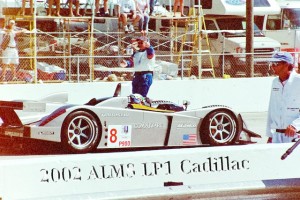
The Racer: 2002 ALMS LP1 Cadillac

Garage Envy — The doors are open!

October 27th, 2008

If I ever had the opportunity to live life large, I would live it exactly the way Jay Leno has. I would buy a very large garage (for starters, something about the size of a Wal-Mart) and I would fill it with as many interesting cars as I could get my hands on. Then I would fill the spaces between the bumpers with automotive artifacts: tools, models, pictures, books, engines, hubcaps, etc. This would not be a museum. Like Jay, I would drive the cars at every opportunity and I would handle and read the artifacts. Everything about cars speaks of action and more often than not, fast action. What better way to live life large.

So what is an ordinary gearhead like you or me to do with only the resources of an average human? Well, we can own a little and dream a lot. So hear goes; Garage Envy will be all about maximizing the little bit we can own and writing about the whole lot we wish we had. Not all that bad, as there are lots of ways to enjoy the things we can’t have. Can’t drive a Ferrari, watch one race. Can’t own a Type 35 Bugatti, visit one in a museum or own a poster or model of one. Never rebuilt an engine, start with your lawn mower. Want to share automotive interests and experiences, read and respond to Garage Envy.

For some, cars are about getting from place to place, for the rest of us cars are the journey, an empty garage is a place to fill. “Let’s motor”, (yes, I do own a Mini).